An intelligent guide that listens to you, corrects you and helps you grow.

Anyone working in a clinical setting knows it: decisions are made under pressure, with data to interpret and limited time. Yet much of the training is still built around linear content, static simulations and cases that are too descriptive.
GPs and specialists need to exercise clinical thinking, not just learn facts. To train their reasoning, their selection of options, their critical evaluation. In environments that reproduce complexity, yes, but that also offer guidance.
Rethinking the role of technology in training
In recent years, a lot has been done to make the learning experience more immersive. We have simulated environments, reproduced virtual patients, integrated AI into clinical dialogues.
But today the real evolution is shifting the focus to the decision-making process, not just the context. The need isn't so much to "see a clinical case", but to reason about why one path is chosen over another. And to do it in a way that is traceable, measurable and adaptable.
The solution: intelligent avatars that guide clinical reasoning
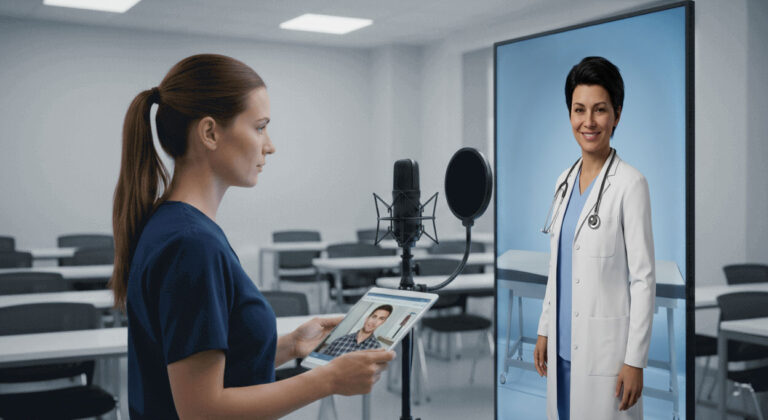
Today it's possible to integrate, within training paths, digital avatars powered by artificial intelligence, able to support the doctor in training during the analysis of complex cases.
Depending on the context, the avatar can take on the role of:
- a virtual patient, with visible clinical signs and a structured history;
- a specialist or tutor, who presents the case, asks questions and stimulates reasoning.
Within the same path it's possible to combine both experiences, alternating phases of observation and clinical analysis with digital patients and moments of guided discussion with the expert avatar.
The professional doesn't observe passively. They interact, reflect and build their own decision, in a continuous exchange that combines visual realism and cognitive guidance.
AI doesn't give you answers. It trains you to build them
Every scenario is designed as a guided path that accompanies the doctor in:
- gathering and interpreting data;
- evaluating hypotheses and therapeutic options;
- comparing possible scenarios;
- justifying their own choice.
Artificial intelligence doesn't replace the teacher or the patient. It acts as a learning lever, helping to:
- highlight critical steps;
- justify decisions;
- make reasoning explicit and replicable.
The value of realism: not just aesthetics, but visual learning
The avatars are built with MetaHuman technology, capable of delivering:
- realistic faces;
- expressions consistent with the clinical scenario;
- details useful for observation (signs, symptoms, relevant traits).
Whether they represent a patient or an expert, these elements enhance attention and clinical analysis, making it easier to connect observation and decision.
Training that measures itself, adapts and evolves
Every interaction is recorded in a structured way. The system collects data on:
- the choices made;
- response times;
- the decision paths followed.
The system generates detailed statistics on choices, timing and interaction patterns. This data is a strategic asset for those who design training, because it makes it possible to:
- assess the effectiveness of the content;
- identify areas for improvement;
- optimize training paths over time.
A new standard for clinical training
This approach represents a concrete evolution compared to previous experiences. It's no longer just about simulating the interaction with a patient. It's about supporting the professional in building clinical reasoning, with a digital guide designed to stimulate, not to simplify.
It's already a reality in paths aimed at GPs and specialists, both in the classroom and in digital environments. And it offers a new balance between rigor, interaction and autonomy.
AI doesn't replace experience: it strengthens it, powers it, structures it. It makes it more useful in practice.
Discover how to make the expert avatar part of your training ecosystem
We help you integrate intelligent avatars and virtual patients into your paths for GPs and specialists, to train clinical reasoning in a realistic, measurable and adaptable way.
Contact us →