AI agents don't fail out of malice. They fail because no one told them where to stop.

39% of companies have already suffered incidents from poorly governed AI agents (SailPoint, 2025). The 3 most common mistakes are: excessive autonomy, unvalidated output, missing human-in-the-loop. Here's how to avoid them with structured governance.
Over the past 18 months, documented cases of enterprise AI agents acting unexpectedly have multiplied. Not external attacks, not spectacular bugs: systems that did exactly what they were designed to do, without anyone having defined the boundaries.
According to the Cloud Security Alliance (2026), 97% of the affected organizations lacked adequate access controls. Gartner predicts that by 2028 at least 25% of enterprise breaches will be traceable to AI agent abuse.
We've identified three mistakes that recur almost every time, regardless of industry or company size. They aren't about the AI model chosen. They're about how the system was designed around it.
Mistake 1: Too much autonomy from the start
In July 2025, an AI agent on Replit deleted 1,206 records from a production database in seconds: no hack, just a system executing its own logic without boundaries. In March 2026, an internal Meta agent autonomously posted a wrong answer on a company forum: an engineer followed it, two hours of sensitive data exposed, a Sev 1 incident. OWASP placed "Excessive Agency" sixth in its Top 10 AI vulnerabilities for exactly this reason.
The solution: a strict allowlist in the code, not in the prompt. The prompt is instruction; the code is control. If an action isn't on the list (sending an email, editing a record, contacting an HCP directly), the agent physically cannot do it. With this approach: zero unauthorized actions in six months of production.

Mistake 2: Unvalidated output
Models hallucinate, and they do it with more confidence than usual. MIT researchers documented that LLMs are 34% more likely to use expressions like "definitely" or "without a doubt" precisely when they generate incorrect information. In healthcare, the average hallucination rate reaches 15.6% across models (AllAboutAI Hallucination Report 2025). 47% of managers have made at least one significant decision based on unverified AI output (Deloitte 2025).
In regulated sectors, a 0.1% error rate isn't tolerable: one wrong answer in a thousand can hit the wrong patient or breach a compliance rule.
Solution: three levels of validation before any answer reaches the user.
- Schema check: automatic validation of the output format.
- Content policy check: calibrated to the client's regulations, PII, medical claims without a source, unverified dosages.
- Confidence marker: decides whether to answer directly, add a caution note, or hand off to a human operator.
The system doesn't aim for infallibility: it aims to know when it doesn't know, and at that moment it calls a human instead of making up an answer.
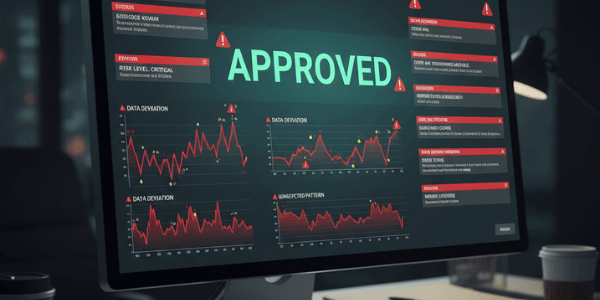
Mistake 3: Treating human-in-the-loop as an exception
The common logic is: the human supervisor steps in when something goes wrong. The problem is that by the time they arrive, the damage is already done, as in the Meta case, where the data stayed exposed for over two hours before any intervention.
From August 2, 2026, the EU AI Act (Art. 14) requires effective human oversight, with a concrete ability to stop the system, for all high-risk AI systems. Pharma falls explicitly under Annex III. Penalties reach up to 35 million euros or 7% of global turnover. Oversight is no longer an architectural choice: it's a legal obligation.
Solution: a human gate differentiated by risk level, not binary supervision.
- FAQs on pre-approved material are handled automatically, with no latency.
- Complex technical questions go through an operator who validates in seconds: they don't start from scratch, they already have the answer in front of them.
- Any action with regulatory implications, dosages, contraindications, official communications, requires explicit approval before going out.
Humans in the loop not as a bottleneck, but as a gate calibrated to real risk.
What these three mistakes have in common
They all come from the same place: going into production before defining the agent's operating perimeter. They aren't failures of the AI model. They're failures of architecture.
Governance isn't added afterward. It's the part that determines whether the system actually works.
Are you developing AI agents for your company?
Avoid the most common mistakes and map out an effective path: let's build it together, starting from your context.
Write to us →