Some respond to keywords; others look at you, talk to you and remember you. Understanding the difference is the first step to choosing the right tool.
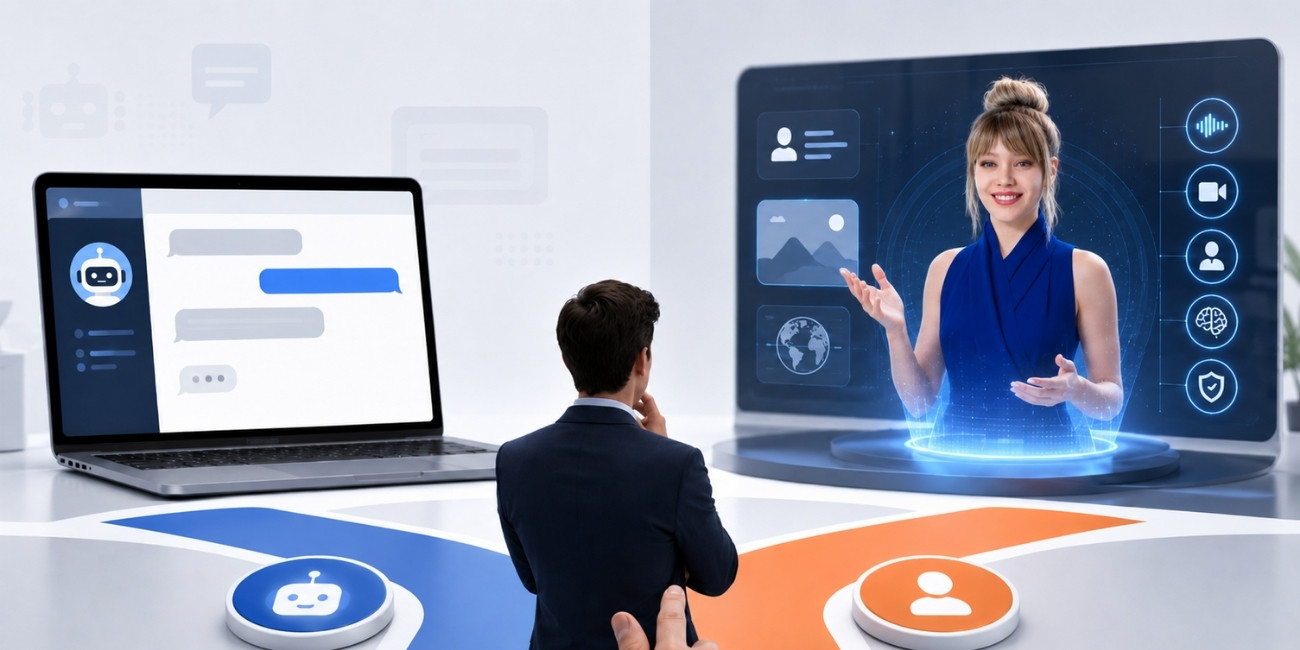
An AI avatar and a chatbot are very different tools: the first has a face, a voice and conversational memory, the second responds to predefined keywords. In this article we explain the technical differences, the ideal use cases and how to choose the right one for your company.
Why the choice matters
In 2026, any company that wants to automate communication with customers, doctors or employees faces a fork in the road: traditional chatbot or AI avatar?
The answer isn't obvious. It depends on the context, the audience, the complexity of the interactions and, above all, the experience you want to offer. A chatbot answering on a FAQ page is very different from an avatar that guides a doctor through training on a new drug, remembers previous questions and answers out loud with a human face.
What a traditional chatbot is (and what its limits are)
A traditional chatbot is a software system designed to simulate a text conversation by following predefined rules or basic language models. Even advanced chatbots have structural limits.
- No visual identity: the chatbot is text on a screen, at most an icon.
- Limited conversational memory: every session starts from scratch.
- Single-channel communication: text only, it doesn't speak or convey emotion.
- Generic compliance: rarely designed with specific regulatory obligations in mind.
What an AI avatar is (and how Linda works)
An AI avatar is a conversational agent with a visual identity (face, body), a realistic synthesized voice and conversational memory.
Linda, the AI avatar developed by Media Engineering, is the most advanced solution available today in Italy for the pharma sector. Linda:
- has a face and a visual identity consistent with the brand;
- speaks with a natural voice, adapting tone and register;
- remembers previous conversations with each person;
- is designed with native EU AI Act and Law 132/2025 compliance.
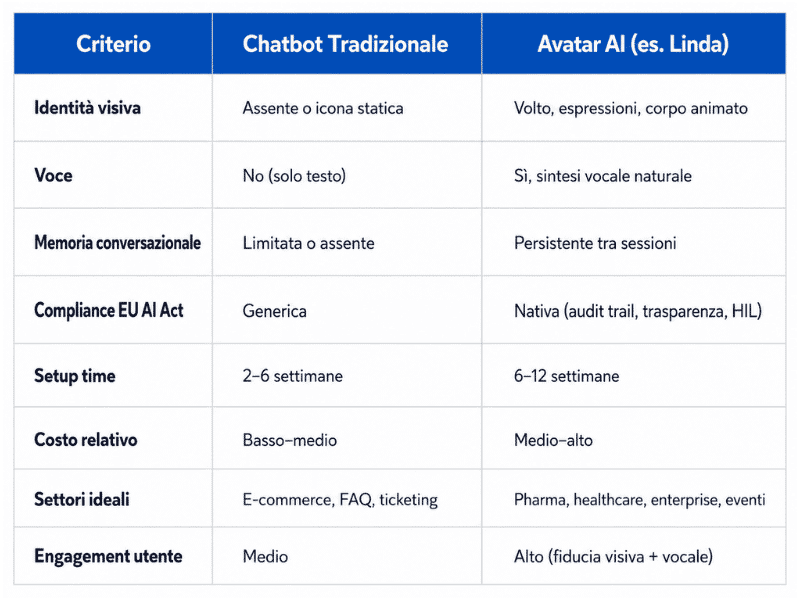
Comparison table: AI avatar vs chatbot
| Feature | Traditional chatbot | AI avatar (Linda) |
|---|---|---|
| Visual identity | Text or, at most, an icon | Face and identity consistent with the brand |
| Voice | Text only | Natural voice, adaptive tone and register |
| Conversational memory | Every session starts from scratch | Remembers previous conversations |
| Channels | Single-channel (text) | Multimodal (voice, face, text) |
| Compliance | Generic | Native (EU AI Act, Law 132/2025) |
| Ideal use case | FAQs, orders, first-level leads | Relationship, training, pharma, events |
When to choose a chatbot
A chatbot is the right choice for first-level customer support (FAQs, orders), lead generation on landing pages, e-commerce, tight budgets and short timelines.
When to choose an AI avatar
An AI avatar becomes superior when the relationship matters more than the transaction.
- Pharma and HCP engagement: presenting clinical data, regulatory compliance, perceived credibility.
- Medical rep training: medical-visit simulations, personalized feedback, performance tracking.
- Enterprise: onboarding, policy training, adaptive learning paths.
- Congresses and events: interactive stands running 12 hours a day with no dedicated staff.
Case study: A.N.N.A. and Alfasigma at the SIMG Congress
A.N.N.A. was developed by Media Engineering in collaboration with Alfasigma and presented at the SIMG National Congress. The avatar interacted directly with doctors, answering questions about the product portfolio in a conversational, engaging way.
The results: doctors interacted longer and with greater satisfaction than with text-based solutions. The engagement rate was significantly higher than the stand's historical averages.
A.N.N.A. was designed with native compliance: audit trail, AI disclosure to the user, regulatory conformity. The data collected could be used safely by Alfasigma.
Discover how Linda works
Tell us about your use case and we'll show you whether an AI avatar or a chatbot is the better choice for your specific context.
Discover Linda →