From AboutPharma's Generative AI for Life Sciences 2026 event: how digital patients and AI avatars are reshaping market access, marketing and patient engagement.
In pharma, digital patients are ready. The real game isn't the technology, but choosing where to use it.
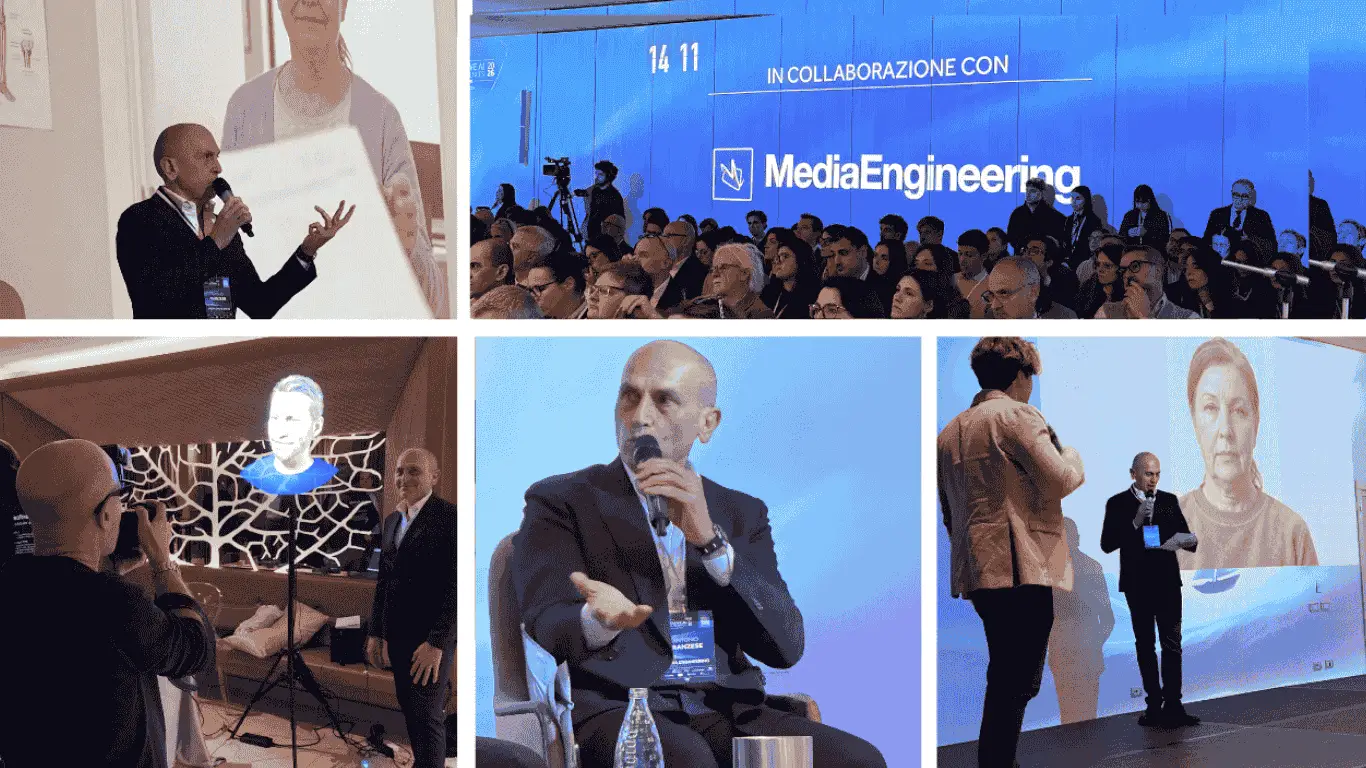
Generative AI in Life Sciences is one of the landmark events for pharma management in Italy, organized by AboutPharma. The 2026 edition, held on March 26 at the Enterprise Hotel in Milan, brought together professionals from pharmaceutical companies, consultants, regulatory experts and technology providers to take stock of where GenAI is really changing the industry's core processes.
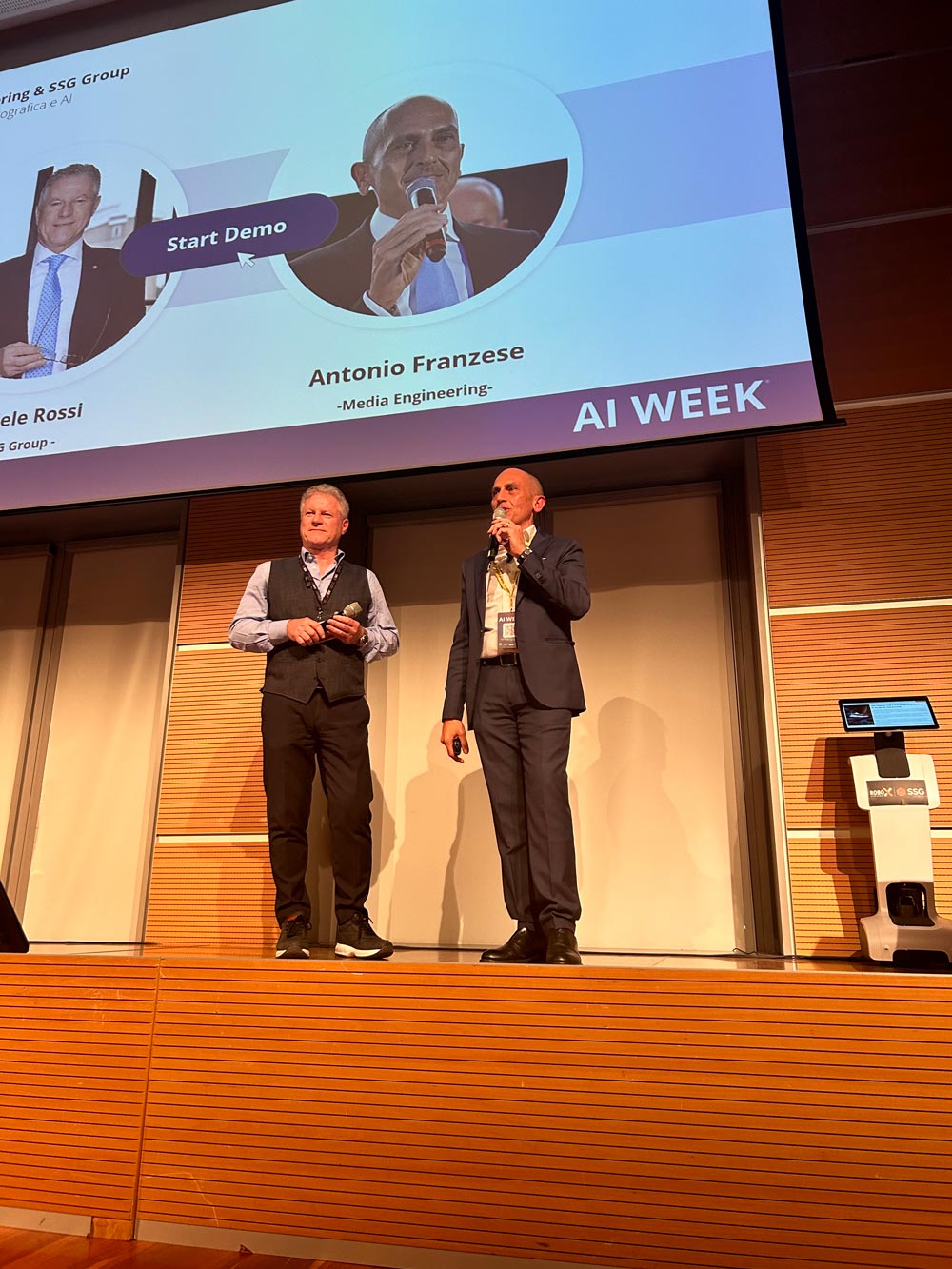
Media Engineering attended as both sponsor and speaker. Antonio Franzese, CEO of Media Engineering, took the stage together with Giulio Lorenzo Pacilio, Product Manager Primary Health Care Vascular at Alfasigma Italia, for the talk "Patient & Treatment Digital Twin: accelerating and improving decision-making in the age of Generative AI". Two complementary perspectives, the strategic areas of use and the field proof, which painted a clear picture of where the sector can go. Antonio then took part in the closing round table on ROI, lessons learned and the scalability of GenAI in Life Sciences.
A territory still largely unexplored
In life sciences, patient digital twins have already proven their value in areas such as medical rep training and medical-visit simulation. But the maturity these technologies have reached now opens up far broader scenarios: market access, marketing, go-to-market, support for HCP clinical decisions.
Antonio built his talk around this opening: Digital Twins are now ready to become an information layer that runs across the entire pharma organization. The technology is mature. The real discontinuity lies in the strategic choice of how and where to use it.
AI-integrated avatars are mature technologies. The real innovation is the strategic choice of how to use them. The pharma sector still has a lot of unexplored territory ahead of it.
Where digital patients are used
In each of the following areas the common thread is the same: the digital patient isn't valuable as a technological object in itself. It's valuable when it becomes the information layer on which people working in clinical and commercial roles make faster, more accurate decisions.
- Market Access: an avatar that articulates the patient's perspective (sensations, emotions, lived treatment experience) as input for those who build dossiers and argue a therapy's value before HTA bodies.
- Marketing and go-to-market: the digital patient as a counterpart for testing messages and positioning before taking them to market, cutting insight cycles from weeks to hours.
- Role play with expert physicians: avatars that simulate specialists or KOLs to prepare commercial and medical affairs teams for scientifically demanding conversations, with realistic objections and a register calibrated to the specialty.
- Training and onboarding: the most established use case, with visit simulations, personalized scenarios and contextual feedback for medical reps and MSLs. With GenAI, no longer fixed scripts but adaptive scenarios.
The Alfasigma case
If Antonio outlined the perimeter of possibilities, Giulio Pacilio of Alfasigma Italia brought to the stage the concreteness of a project already up and running.

Digital Patient for HCP engagement and ISF/MSL training
Alfasigma Italia developed, in collaboration with Media Engineering, a digital patient aimed at doctors and medical representatives, designed to support the interaction between the commercial force and the clinical world.
Not a generic chatbot: an avatar built around a defined therapeutic profile, integrated into the daily workflow of doctors and reps. Its strength lies in its specificity: it responds to the concrete needs of those who have to communicate complex therapies to demanding interlocutors, with a level of conversational fidelity that only generative AI makes possible today.
These aren't future scenarios. The project tackles real challenges: simulating complex conversations, preparing for specific objections, training the ability to communicate value in scientifically demanding contexts.
Does the Digital Patient deliver measurable ROI?
It's the question pharma Marketing Directors ask most often. The answer is clear: a patient Digital Twin is worth nothing if it remains a technological object in itself. It's worth a lot when it becomes the information layer on which the HCP makes faster, more accurate decisions.
That's where ROI is measured: in reduced decision time, in the quality of engagement, in fewer follow-up cycles.
You don't measure the value of the technology in itself, but the impact it produces on the physician's decision-making behavior. A shift in perspective that moves the digital patient from experimental innovation to tools with concrete clinical and commercial impact.
What changes with Generative AI
Avatars existed before the generative era. The turning point introduced by Large Language Models is deep conversational capability: a digital patient that doesn't respond to predefined scripts, but reasons, contextualizes and reacts coherently even to unexpected questions. A generative avatar can simulate a relationship, with the emotional nuances and real concerns that make a patient a patient, not an abstract clinical case. It's this qualitative difference that structurally opens the door to market access, marketing and patient engagement.
The compliance challenge: EU AI Act and Law 132/2025
Italian Law 132/2025 requires that any AI system interacting with users in professional contexts explicitly declare that it's an artificial intelligence. For a digital patient in pharma, this isn't a detail: it's a legal requirement with concrete implications.
The EU AI Act classifies AI systems in healthcare as "high risk": they require transparency, traceability and documented human oversight. Compliance isn't added afterward, it's designed from the start.
Let's build the right path together
Tell us where you want to start and we'll define the Digital Patient use case that best fits your company.
Write to us →