A structured 4-week path to move from pilot projects to real adoption of artificial intelligence.

Artificial intelligence is entering companies with an impact faster than digitalization and deeper than the Internet. It's no longer a question of "whether to adopt it", but of how to integrate it in a concrete and secure way.
Many organizations have already moved, but often with limited results: pilot projects that never get past the prototype stage, tools introduced without clear governance, teams split between those using ChatGPT, Claude or Perplexity and those still working the traditional way.
The result is fragmentation, data loss and a growing productivity gap. To move beyond this scenario, you need a structured method that starts from the teams and not from the entire organization.
Why bringing AI into your company is a priority
International research clearly shows the potential of AI:
- according to McKinsey (2023), generative AI can automate up to 60-70% of existing work activities;
- PwC (2023) estimates that AI will contribute around 14% of global GDP by 2030;
- for Accenture (2023), generative AI can increase the productivity of knowledge workers by up to 40%.
This means the problem isn't whether to adopt AI, but how to do it effectively, avoiding an uncontrolled proliferation of tools, the scattering of data and a fragmented use that slows things down instead of speeding them up.
The most common mistakes in AI adoption
Many organizations approach artificial intelligence with enthusiasm, but fall into a few recurring mistakes that limit its potential:
- Transforming the entire organization at once. Such a radical change can't happen from the top in a single step. Teams, with their daily processes, are the real protagonists of the transformation.
- Focusing only on technology. Introducing new tools without reviewing processes just creates more chaos. AI only makes sense when integrated into structured and well-defined workflows.
- Ignoring training. Without adequate skills, AI tools risk becoming little more than isolated experiments. The difference is made by people's ability to use them consciously and strategically.
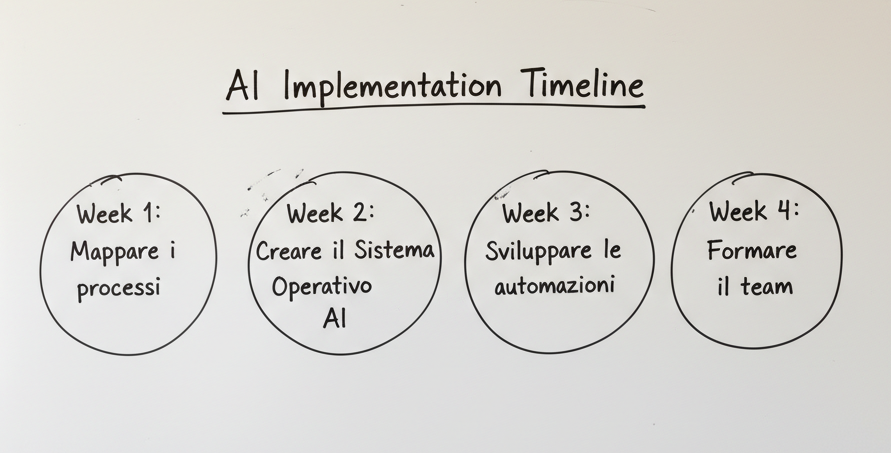
The 4-week method to introduce AI into teams
The proposed method is organized over four weeks, each with precise objectives.
Week 1: Map the processes
The first step is to observe what already exists. Analyzing internal workflows makes it possible to understand how current processes work and where inefficiencies are generated.
- An analysis of current workflows is carried out.
- Repetitive activities and those of higher strategic value are identified.
- The bottlenecks that slow down productivity and collaboration are pinpointed.
The goal of this phase is to build a clear picture of the organization, essential to define where and how AI can usefully intervene.
Week 2: Build the AI Operating System
Once the processes are mapped, you move on to designing the new flows. In this phase you draw a kind of "operating system" that integrates AI into daily work.
- The new processes to implement are defined.
- The most suitable tools among those available on the market are chosen.
- Work is done on integration with the company systems already in use, to avoid duplication or silos.
The result is an operational architecture that makes AI part of the work, and not an occasional add-on.
Week 3: Develop the automations
With the processes redesigned, it's time to introduce automations that simplify daily activities. AI isn't an end in itself: it must turn input into concrete actions.
- Custom prompts are created for the needs of the business.
- Automated workflows are designed to handle repetitive activities.
- Company data is connected to make the automations reliable and contextualized.
This way, AI becomes an operational ally that frees up time and reduces errors.
Week 4: Train the team
Technology alone isn't enough: people need to learn to use it consciously. That's why the final phase is dedicated to training and change management.
- The new flows are tested to verify their effectiveness.
- People are prepared for the new roles and responsibilities that come with using AI.
- Rules and continuous monitoring systems are defined, to ensure constant updating and progressive improvement.
This week marks the shift from experimentation to full adoption: teams become able to use AI independently, without losing control or critical vision.
What you get with this approach
A gradual and structured path doesn't only bring an increase in productivity: the real change concerns the way teams experience and interpret their work. AI, integrated with method, becomes an ally that frees up time and empowers people.
On average, each person can reclaim about 4 hours a week, thanks to the reduction of manual and repetitive activities.
The main observable results are:
- Measurable time savings. Fewer manual and repetitive activities, more time for what matters.
- More fluid and scalable processes. Removing bottlenecks makes it possible to manage complex flows with greater speed and consistency.
- Greater autonomy and responsibility within teams. People don't just carry out tasks, they become protagonists of the process, able to act with decisiveness and creativity.
- A new relationship with work. Freed from the more mechanical activities, professionals can focus on higher value-added aspects: critical thinking, innovation, collaboration and relationship building.
This approach doesn't replace the human contribution, it amplifies it. AI doesn't make strategic decisions in place of people: it creates the conditions for them to think and act better, with more powerful tools at their disposal.
Conclusion
AI doesn't replace people: it empowers them.
With the right method, your company can avoid the chaos of fragmented tools and turn your teams' work into a real competitive advantage.
Discover how to apply this method in your company
We show you how to move from pilot projects to real AI adoption, starting from your teams and your processes. Contact us for a personalized demo.
Contact us →