The right data, in the right format, at the right time: digital twins are reshaping reimbursement negotiations in pharma.
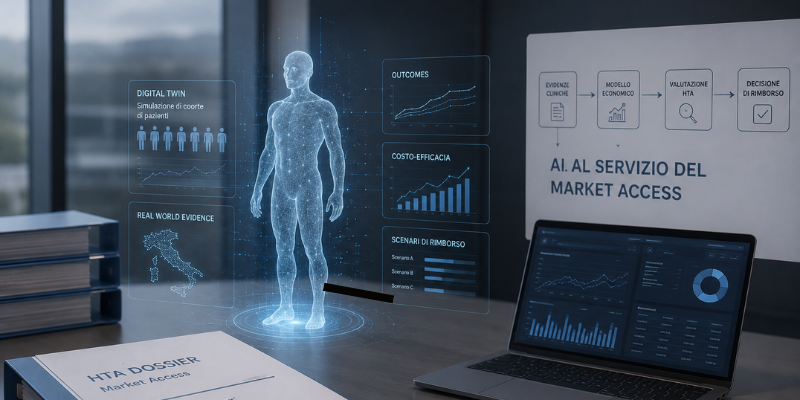
Every year, drugs that work wait months, sometimes years, to secure reimbursement. Not because their efficacy is in question, but because the right data, in the right format, isn't available at the right time. A digital twin isn't the answer to everything, but for anyone working in market access who knows the real cost of those delays, it's the technology worth understanding now, before competitors do.
What a digital twin means in pharma and HTA
A digital twin in healthcare is not a simple simulation. It's a dynamic digital replica, of a patient, a cohort, a treatment pathway, built on real data and updated in real time.
In market access, it makes it possible to simulate the therapeutic response of specific populations before real-world data is available, build more accurate and defensible cost-effectiveness models, generate comparative evidence against existing standards of care, and support AIFA dossiers with methodologically validated synthetic data.
The problem with traditional HTA dossiers
Evidence gaps. Registrational trials are designed for controlled conditions, while HTA agencies want to know what happens in real clinical practice.
Incompatible timelines. Collecting real-world evidence takes years: the competitive window closes long before that.
Limited comparative data. A direct comparator doesn't always exist within the trials.
Uncertainty in economic models. Traditional Markov models rely on assumptions that agencies systematically challenge.
How the digital twin addresses these problems
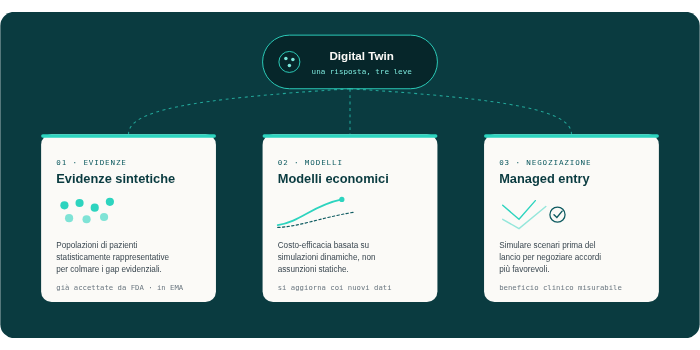
Synthetic evidence to close the gaps. A digital twin makes it possible to generate synthetic patient populations, statistically representative, to simulate treatment effects: an approach already accepted by the FDA for some devices and currently under discussion at EMA.
More robust economic models. A digital twin of the treatment pathway makes it possible to build cost-effectiveness models based on dynamic simulations rather than static assumptions, updatable as new data arrives.
Support for managed entry negotiations. Managed entry agreements require defining in advance how clinical benefit will be measured: a digital twin built before launch makes it possible to simulate different scenarios and negotiate more favorable agreements.
Digital twins for Medical Affairs training
Medical Affairs teams need to prepare for technically complex conversations with AIFA, hospital pharmacists, and regional PTR commissioners. An AI avatar trained on the product dossier lets teams rehearse real scenarios and standardize communication across the territory: this is exactly the kind of application developed with A.N.N.A. for Alfasigma.
Where things stand today
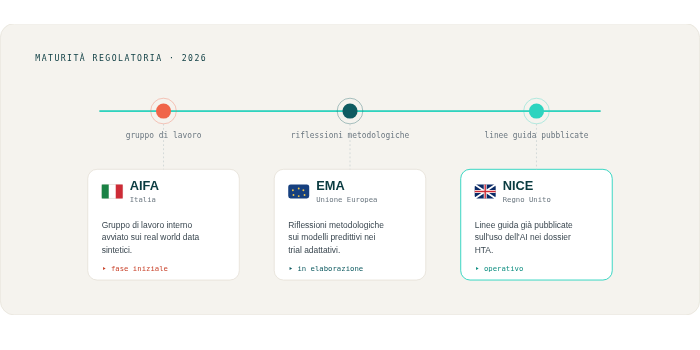
In Italy, AIFA has launched an internal working group on synthetic real-world data. In the UK, NICE has already published guidelines on the use of AI in HTA dossiers, while EMA has released methodological reflections on the use of predictive models in adaptive trials.
What to do next: the first steps
A concrete path starts with mapping the evidence gaps in your dossier, continues with assessing the quality of available data, involving the methodology team early, exploring technology partners with pharma experience, and training the team on how to communicate these tools to agencies and stakeholders.
The digital twin in market access isn't a trend: it's a concrete response to real problems, evidence gaps, long timelines, fragile economic models, difficult negotiations.
Are you evaluating a digital twin for your market access dossier?
Tell us about your product and the evidence gaps you're facing: we'll show you how a digital twin could support your HTA negotiation.
Contact us →