Role play with a colleague isn't enough anymore. Here's what's taking its place, with real numbers.

Training a pharmaceutical sales representative has always been a high-risk investment. Classroom hours, role play with colleagues, printed materials and subjective feedback all add up to results that are hard to measure and an experience that is hard to standardize. Now, however, AI is changing this equation in a radical and measurable way.
To begin with, the pharmaceutical sector is one of the most heavily regulated in the world. As a result, rep training must comply with strict regulations (Law 132/2025, Legislative Decree 219/2006), guarantee absolute scientific accuracy and produce professionals who can handle complex conversations with specialist physicians. In fact, a training mistake is not just a performance problem, because it can carry serious legal and reputational consequences.
Yet until a few years ago, the available tools were essentially the same as they had been for decades. Today, by contrast, that is no longer the case.
The problem with classic pharma rep training
Anyone who has worked in a pharma sales force knows the limits of the classic model. In practice, four of them stand out.
- Standardization is impossible. Every trainer brings their own interpretation, and each role play unfolds differently. As a result, a rep based in Milan gets different training from one in Palermo.
- Feedback is subjective. Phrases such as "you did well" or "you need to improve your closing" are not metrics. Therefore, they can't be tracked, compared or systematically improved.
- Scale is limited. A single trainer can follow only 10-15 people per session. Consequently, a team of 200 reps requires months of training, while costs and timelines keep multiplying.
- Practice is insufficient. Real learning happens in the medical visit, not in the classroom. However, the first real visits come at a very high cost: impressions that are hard to correct, lost opportunities and mistakes that stick.
How AI solves these problems
AI does not replace the human trainer. Instead, it multiplies their effectiveness, stepping in exactly where the classic model falls short.
1. The simulated doctor: unlimited roleplay, available 24/7
Imagine an AI avatar that plays a skeptical cardiologist, a GP in a hurry or an oncologist asking difficult technical questions. With it, the rep can practice any scenario, as many times as they want, and receive immediate, objective feedback.
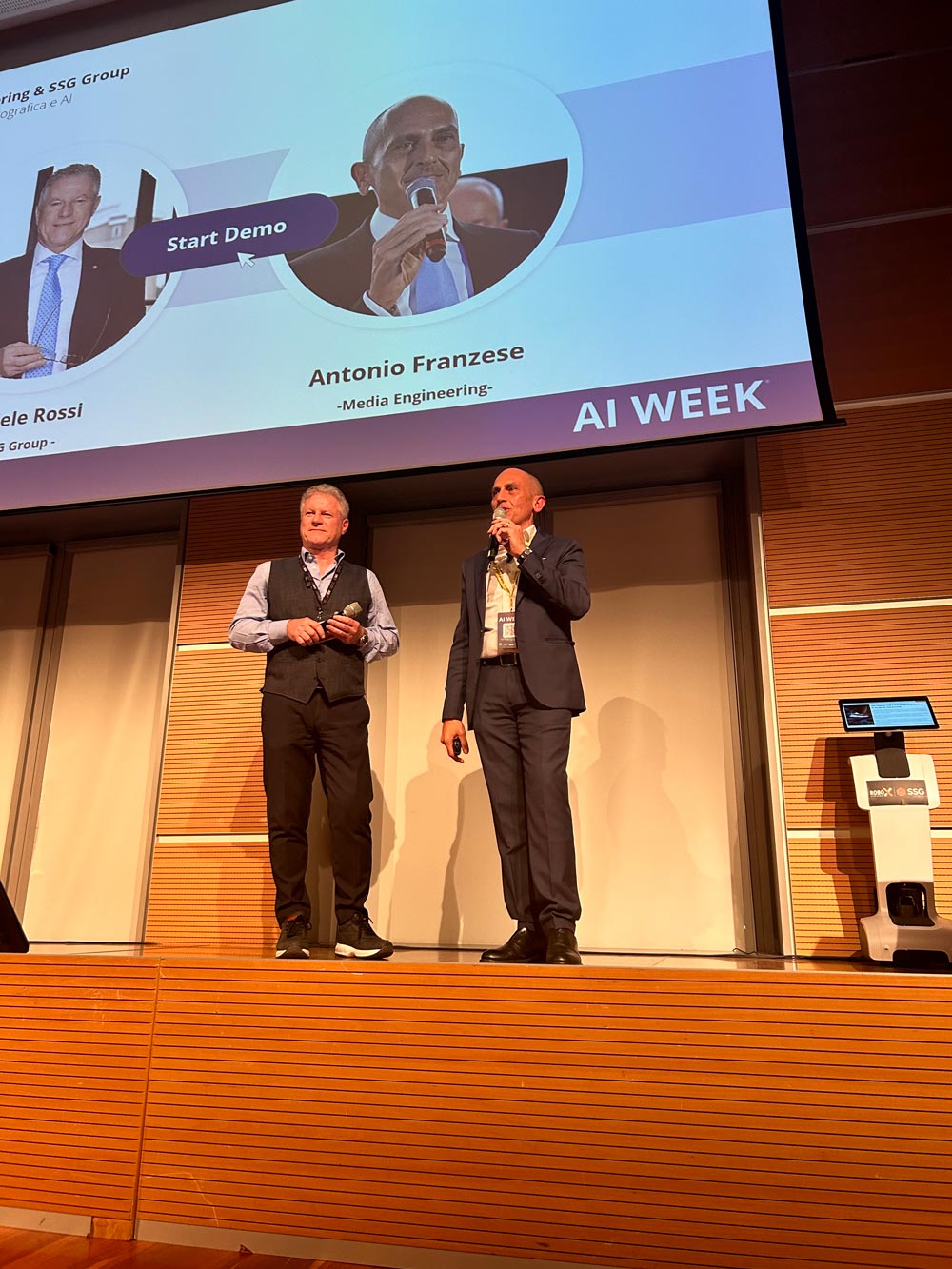
This is not science fiction. In fact, it is exactly what we are doing at Media Engineering with our digital twins for pharma training.
During each session, the system evaluates:
- the accuracy of the information provided,
- objection handling and adherence to the approved claim,
- the naturalness of the conversation,
- and the timing and structure of the visit.
Afterward, every session produces a detailed report. As a result, the training manager can see in a dashboard where each rep is strong and where they need to improve.
2. The product digital twin: always up-to-date training
Every time a package insert changes, a new clinical trial arrives or a therapeutic indication is updated, training has to follow. With traditional systems, however, this means new materials, new sessions and new travel.
With an AI avatar trained on the product, by contrast, the update is immediate. Once the system is retrained on the new data, all reps gain access to the updated version in real time.
3. Native compliance: no off-label risk
One of the biggest risks in pharma rep training is off-label drift, when a rep, even in good faith, communicates unapproved information. With an AI avatar trained on the exact claim and on materials approved by the regulatory department, however, this risk is eliminated at the source. Simply put, the system cannot say what it is not authorized to say.

The A.N.N.A. case: the real numbers
A.N.N.A., the AI avatar developed by Media Engineering for Alfasigma, was the first Italian project to bring this technology into a real, measurable pharma context.
For example, the pilot on 200 general practitioners produced results that speak for themselves: photorealism and multimodal interaction leave a more lasting impression than any written document. Moreover, engagement and information-retention KPIs exceeded the client's previous benchmarks.
In addition, the project addresses a universe of 35,000 professionals, a level of scalability that no team of human trainers could ever reach.
So what was the outcome? The project won the AboutPharma Digital Awards 2026, in the Artificial Intelligence for Communication, Education and Training category. Notably, it became the first institutional pharma recognition for an AI avatar project in Italy.
EU AI Act and pharma rep training: what changes
With the Digital Omnibus of May 7, 2026, the deadlines for high-risk AI systems have been pushed back. Nevertheless, one obligation remains confirmed.
By December 2, 2026, AI systems used in communication, including avatars and simulators for training, must comply with transparency obligations.
For those using AI avatars in pharma rep training, therefore, this means designing compliance from the start rather than adding it as a patch. That is why the systems Media Engineering develops have regulatory compliance (Law 132/2025, EU AI Act, GDPR) built into the architecture, not as an external constraint but as part of the design.
When does it make sense to adopt AI in pharma rep training?
Not every company is ready at the same time. Still, some clear signals indicate that the moment is right:
- Your sales force exceeds 50 people and standardizing training has become difficult.
- Training costs, including travel, hotels and trainer hours, weigh heavily on the budget.
- New reps take too long to reach full competency.
- A new product launch means the whole network has to be trained quickly.
- Past episodes of off-label communication are something you want to prevent.
If you recognize yourself in at least one of these scenarios, then it's worth exploring the options available today.
Conclusion
AI-powered pharma rep training is not a future promise. On the contrary, it is an operational reality, with measurable case studies, clear costs and a regulatory framework that is settling into place.
As a result, pharma companies that start today will gain a real competitive advantage over the next 18 months: better-prepared reps, faster training and stronger compliance.
Those that wait, by contrast, will pay for the delay in time, in quality and in lost opportunities.
Thinking about an AI avatar to train your reps?
Tell us how your sales force is organized and we'll show you how an AI avatar can make training faster, more standardized and compliant.
Contact us →