A structured 4-week journey to move from pilot projects to real-world adoption of artificial intelligence
Why bringing AI into your company is a priority
- according to McKinsey (2023), generative AI can automate up to 60–70% of existing work activities;
- PwC (2023) estimates that AI will contribute approximately 14% to global GDP by 2030;
- according to Accenture (2023), generative AI can increase the productivity of knowledge workers by up to 40%.
Questo significa che il problema non è se adottare l’AI, ma come farlo in maniera efficace, evitando una proliferazione incontrollata di strumenti, la dispersione dei dati e un utilizzo frammentario che rallenta invece di accelerare.

The most common mistakes in AI adoption
The 4-week method to introduce AI into teams
To move from isolated pilot projects to real-world adoption of artificial intelligence, a clear path structured into progressive phases is required. A gradual approach reduces risk, supports change management, and allows people to adapt naturally to new tools.
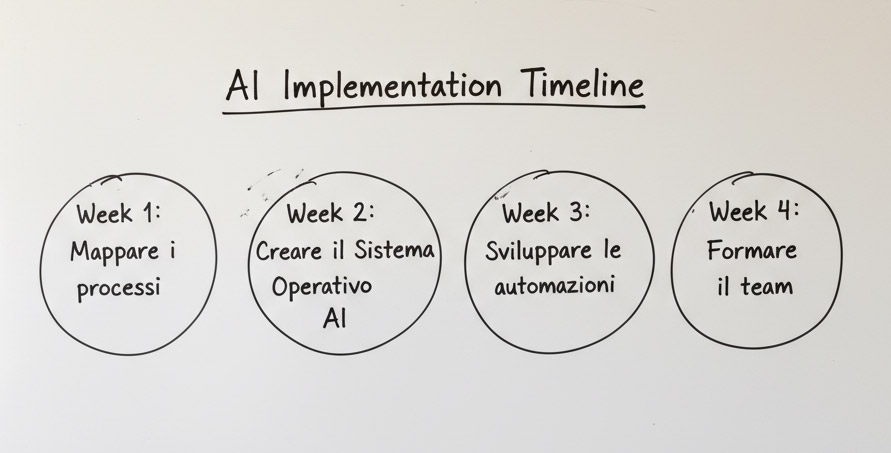
The proposed method is structured over four weeks, each with clear objectives:
Week 1: Mapping processes
The first step is to observe what already exists. Analyzing internal workflows makes it possible to understand how current processes operate and where inefficiencies arise.
- Current workflows are analyzed.
- Repetitive activities and those with higher strategic value are identified.
- Bottlenecks that slow productivity and collaboration are highlighted.
The goal of this phase is to build a clear snapshot of the organization, which is essential to define where and how AI can intervene in a truly useful way.
Week 2: Building the AI Operating System
Once processes are mapped, the focus shifts to designing new workflows. In this phase, a kind of “AI operating system” is created to integrate AI into everyday work.
- New processes to be implemented are defined.
- The most suitable tools available on the market are selected.
- Integration with existing company systems is designed to avoid duplication or silos.
The result is an operational architecture that makes AI part of daily work, rather than an occasional add-on.
Week 3: Developing automations
With redesigned processes in place, it’s time to introduce automations that simplify daily activities. AI is not an end in itself: it must turn inputs into concrete actions.
- Custom prompts are created based on business needs.
- Automated workflows are designed to handle repetitive tasks.
- Company data is connected to make automations reliable and context-aware.
In this way, AI becomes an operational ally, freeing up time and reducing errors.
Week 4: Training the team
Technology alone is not enough: people must learn how to use it consciously and effectively. For this reason, the final phase is dedicated to training and change management.
- New workflows are tested to verify their effectiveness.
- Team members are prepared for new roles and responsibilities enabled by AI.
- Rules and continuous monitoring systems are defined to ensure constant updates and ongoing improvement.
This week marks the transition from experimentation to full adoption: teams become capable of using AI autonomously, without losing control or critical perspective.
What you gain with this approach
A gradual and structured journey delivers more than just increased productivity: the real change lies in how teams experience and interpret their work.
When integrated with a clear method, AI becomes an ally that frees up time and empowers people.
The main observable outcomes include:
Measurable time savings
On average, each person can regain around 4 hours per week, thanks to the reduction of manual and repetitive tasks.
Smoother and more scalable processes
Eliminating bottlenecks makes it possible to manage complex workflows with greater speed and consistency.
Greater autonomy and accountability within teams
People move beyond task execution to become true owners of the process, able to intervene with confidence and creativity.